Personal finance MOT


john_vernon_lord_ant_grasshopper

In a field one summer’s day a Grasshopper was hopping about, chirping and singing to its heart’s content. An Ant passed by, bearing along with great toil an ear of corn he was taking to the nest.
“Why not come and chat with me,” said the Grasshopper, “instead of toiling and moiling in that way?”
“I am helping to lay up food for the winter,” said the Ant, “and recommend you to do the same.”
“Why bother about winter?” said the Grasshopper; we have got plenty of food at present.” But the Ant went on its way and continued its toil.

When the winter came the Grasshopper had no food and found itself dying of hunger, while it saw the ants distributing every day corn and grain from the stores they had collected in the summer. Then the Grasshopper knew: It is best to prepare for the days of necessity.

Source. (See Martin Wolf’s re-telling of the Ant and the Grasshopper as a modern fable here).


I endorse Chris Dillow’s four general principles of investing:

  1. Live within your means. The safest way to get rich is to save. How you invest your savings – cash, shares, gold, whatever – is a secondary consideration, unless you are really silly.
  2. Minimize taxes and charges. Most people can save tax-efficiently through ISAs and pensions, and should do so. Also, don’t be tempted by high-charging funds – they are usually not worth it. And if you hold shares directly, don’t trade much.
  3. Remember that high prices, on average, mean low expected returns. Don’t jump on bandwagons.
  4. Remember G.L.S Shackle’s words: “knowledge of the future is a contradiction in terms.” Don’t pretend you can see what’s coming. And don’t pay others in the belief that they can do so. The essential fact about the financial world is risk (and/or uncertainty). The key question is: what risks are you prepared to take, and which aren’t you? This paper by John Cochrane discusses this well.

I like Harold Pollack’s attempt to put financial advice on a 4×6 index card:
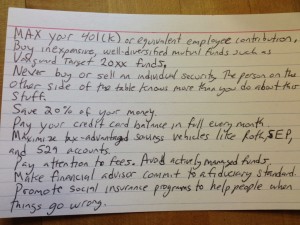
Photo by Harold Pollack

Photo by Harold Pollack

I recommend this investment philosophy from Jim O’Shaughnessy. And I think Kyla Scanlon is right when she says that “time in” is more important than “timing” (see Conversations with Tyler, Ep. 222, November 2024.)

And I enjoyed listening to Bill Ackman channel his inner Warren Buffett to explain his approach to (and his defense of) activist investing: #413 – Bill Ackman, Lex Fridman podcast, February 20th 2024.

Many people will say that they want to take more control over their current spending and future financial security, but often find it difficult to actually achieve this. I’m not a qualified financial adviser, I can’t demonstrate past success at investment decisions, and I do not encourage you to blindly follow my advice. All I can offer is a process by which you can gain a better understanding of your personal finances, and something that seems to work for me.

You probably don’t have time to follow these steps now. So find a date a few weeks or months from now and put it in your diary. Don’t shift it. Treat this seriously. Do it when you have time…

Preamble

Picture yourself at 65, and make it as vivid an image as possible – not so much what you look like, more where you are and what you are doing (for more on this approach see Chapter 9 of this book). A large reason why people are careless with their financial situation (and constantly undermine their future happiness) is because we’re conditioned to focus on immediate rewards. But we need to shift perspective and think about what actions your present self needs to take in order to make your future self happy. What resources do you need to deliver to your 65 year old self? Picture your children at 20. What do you want to be able to give them? Having to adjust your future goals to meet your financial resources is failure. Instead, you should adjust your present behaviour to hit your targets. Practice self-control and delayed gratification. If you want to watch a movie, try waiting a few days. Treat it as a reward.

In

  • Go through your last 6 payslips and use your typical (i.e. not including bonuses) net (i.e. after tax) income. Unless bonuses are a significant part of your regular income then treat them as a bonus.

Out (Monthly bills)

  1. The only outgoings I measure are household bills. To do this I check all of my direct debits and fill in a summary sheet (download a PDF here). If I have a DD I put the amount in the “monthly DD” column. If I pay it annually I put it in the “annual” column and then write the month in which it is paid in the “Month” column next to it. Ideally these are spread out throughout the year. The spreadsheet will automatically calculate the “annual sum” and then there are two figures for “monthly sum”, which are the total of all the monthly DD payments and the total of the annual payments divided by 12. Finally, the “monthly total” is the sum of those two numbers, revealing how much I spend on household bills, on average, every month. The categories I use are:
    • Mortgage; Savings (these are Junior ISA’s for the kids); Tax (Council tax, Car tax, TV license); Utilities (Water, Gas & Electric, Phone & broadband); Insurance (Home, Car, Central heating, Travel, UK Breakdown, EU Breakdown, Pet); Life insurance; Sports (i.e. kids sports clubs)
  2. My wife and I use our joint account for those bills and only those bills. I make sure that we have a standing order that exceeds this amount going in at the beginning of each month.
  3. In addition to household bills our main spending areas are: food, petrol, commuting, clothes, other. I am fortunate enough to not have to keep track of these, however if I did I would use the budget feature in Monzo to do so. I use my own current account to cover payments for things such as Mobile phone; Spotify; Netflix; Google Nest – but these are typically less than £20.

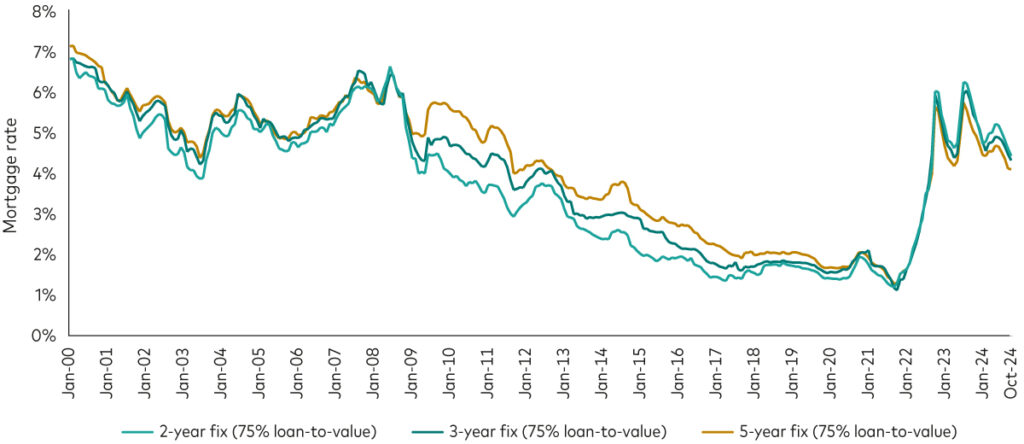
Don’t want to boast or anything but I took out a 10 year fixed rate mortgage at under 3% in 2022. It is humbling to note that perhaps the most impactful driver of my long term financial health was due to immense conservatism and (thus far) fortuitous circumstances.
Shake it all about

  • Once a year I update an overview of my net wealth (download a PDF here).
  • If like me you’re lucky enough to own your own home, this is likely to be the biggest component, and I use a rough estimate of the market price less the outstanding mortgage. I own shares in 2 companies and list these based on the current share price. The investment ISAs include managed funds as well as an easy access Vanguard account. (If it takes a long time to find a current balance then perhaps that’s a problem. But then again, if you’re checking them more than once a year that may also be a problem. You want to “Set it, and forget it“.) We also have savings pots in our Monzo accounts for things like holidays and the sum of those 5 categories is what I consider to be my net wealth.
  • A decent proportion of net wealth is pensions and this can be hard to measure, but most providers will show a current value. Make sure you max out any matched contribution and have a figure as hugh as you can afford (>25%). My wife and I have opened SIPPs but I’m still not sure whether they should be prioritised over ISAs.
  • Below that, I include the balance of my children’s Junior ISAs which is nice to know, but not “our” wealth.
  • I don’t include the balance of current accounts because these tend to be low and volatile. Monzo pots have been a real help to allocate specific spending commitments, such as holidays, Christmas, kids extra-curricular activities, car maintenance, house maintenance, and vets bills.

Some general comments:

  • Utilise as much as your tax free allowance as possible on your ISA.
  • Get a good credit card. Make sure you pay it off each month but make sure you’re getting rewards for spending. An easy way is to link it with Airmiles.
  • For advice on what type of pension, life insurance, and savings vehicle are appropriate for you consult a professional financial advisor (this is helpful). If you don’t think it’s worth paying a few hundred quid to sort out your financial future then you’re an irresponsible idiot!
  • It is really important to start saving early. “Someone who starts saving at the age of 21 and then stops at 30 will end up with a bigger pension pot than a saver who starts at 30 and puts money aside for the next 40 years until retiring at 70“. Also look at the calculators here.
  • Have a look at the interest rates you’re paying. Make sure that you pay off your most expensive loans first.
  • Act as though the Efficient Market Hypothesis is true. The best investment strategy is a low cost well diversified index fund. Vanguard are the original and remain the best (and even after the turmoil in Spring 2020, if your goals are long term you shouldn’t even be looking at it). I use the FTSE Global All Cap index, although
    • The ESG Developed World All Cap Equity Index Fund is very similar but reduces emerging market risk (I think).
    • The Lifestrategy 100 is more UK based, which reduces exchange rate risk.

Student loans

I didn’t have a student loan and know they’re controversial, but according to Martin Wolf (2023, p. 285) in an ideal world…:

  • Lower fees (£9k is too high)
  • An equity component to the contract such that higher earning students pay more than their loans
Finally

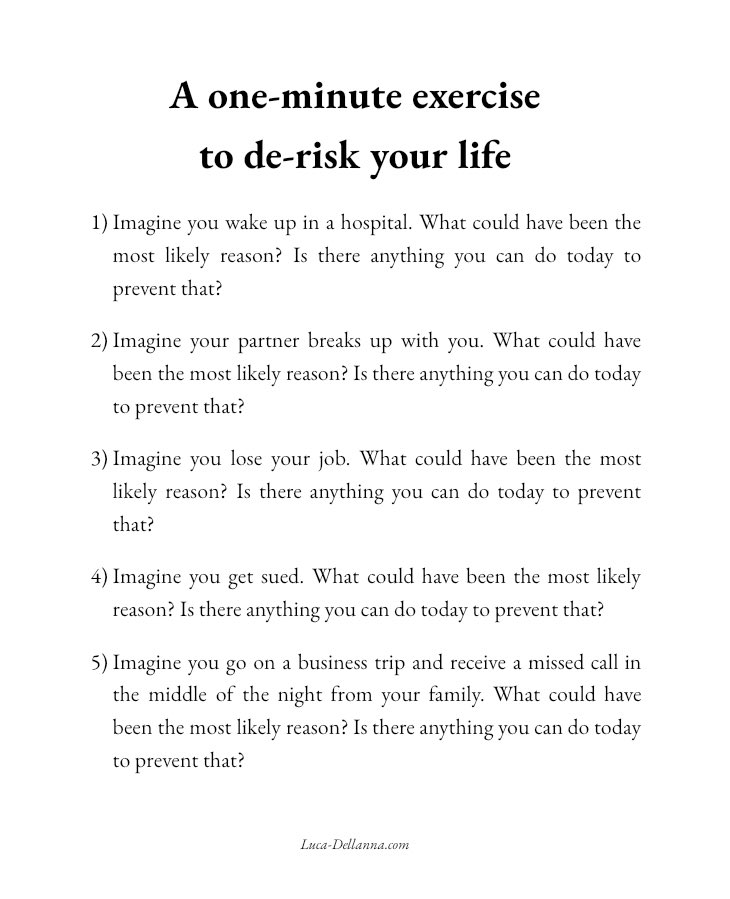
This advice for personal financial can be extended to life more generally. Here’s an example of a pre-mortem for personal decisions:
Charity

I don’t enjoy being asked to make donations to charity, and not solely because I’m a tight, selfish bastard. It’s because it’s a form of bullying – you are put under social pressure to make a quick decision.

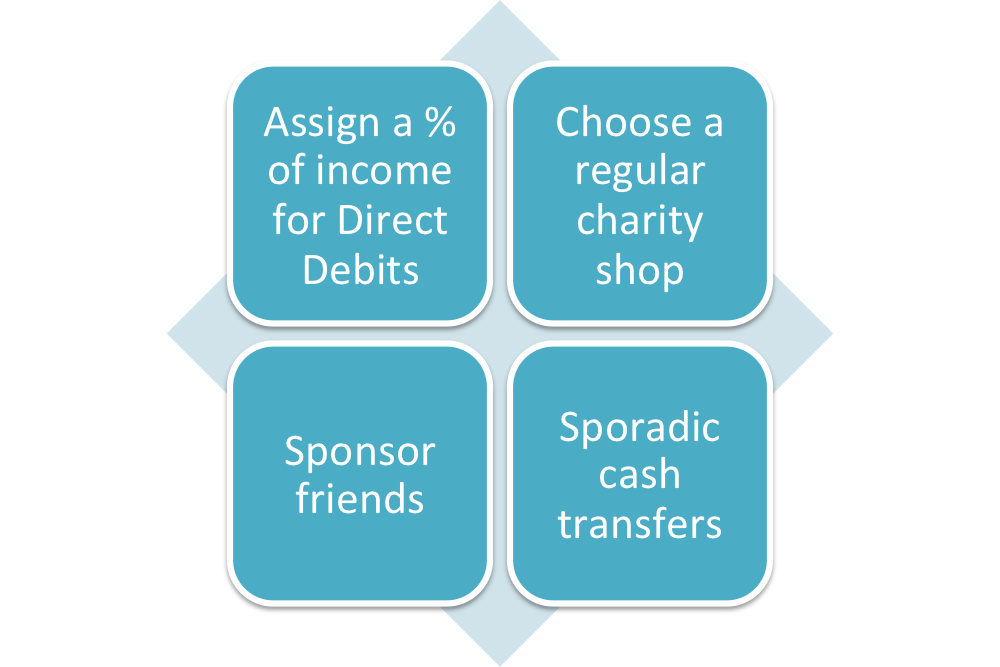
My response is to have an articulated approach to charitable donations, which serves as a defense mechanism and means I can avoid treating each request as something that requires my attention. I prefer to have a charity rule, rather than have to judge each request on its case-by-case merits. In a nutshell here it is:

charityPerhaps some points of explanation and elaboration are in order:

  • I believe that the best way to help people out of poverty is through economic liberalisation. I find the empirical and theoretical evidence compelling, and devote my career to pursuing it. This sounds glib and self-satisfying but writing a book about the power of markets is my chief contribution. Economics is my Ikigai and when my children ask me what I’ve done to make poverty history, my response is “public education”. And I sleep well at night.
  • Of course, I can do more. However I’m very concerned about inefficiencies within the charity sector. Since they exist largely outside the profit and loss framework that I deem to be the cause of the success of markets, it is to be expected that they are subject to bureaucratic inefficiencies. I suspect that the charities I’m most familiar with, are not necessarily the most important. I suspect that the causes that generate most media coverage, are not necessarily the most pressing. So I try to discount charities that have good branding, good PR, and are emotionally draining. That said, GiveWell seem to be doing a good job of evaluating the effectiveness of charities.
  • I think it’s important to have direct debits to charities that you believe in. I set a percentage of my income that I feel is appropriate and split that between a few well known charities. One is focused on democracy and basic human rights. One is focused on humanitarian assistance and medical aid. If another charity wants me to contribute to them, they’ll need to convince me either that (i) they are more deserving than a charity I currently support; or (ii) I should increase the percentage of my income I assign to charitable giving. A Tithe requires 10%, but I already donate more than that to the UK government to administer charitable giving on my behalf. So I don’t give 10%. Less than that. If the state shrank, I’d give more.
  • I never donate based on cold calling, be it at home or in the street. This is a rule and the more you encourage me to break it, the more resolute I will be. Don’t bully me!
  • I regularly make donations of clothes, toys, DVDs etc to my favourite local charity shop.
  • Whenever I bet on beliefs I suggest to donate proceeds to charity.
  • I am not as skeptical of government-to-government foreign aid as most free market economists, because I believe that even with large scale bureaucratic inefficiencies the end result could still be beneficial. If for every £1 that gets sent abroad 50p is lost to bureaucracy, 25p goes to prop up a bad regime, and only 25p goes to intended recipients; that may be better than 0. But there’s important incentive effects that should be considered.
  • As an alternative to foreign aid, I’m delighted that the practice of giving cash transfers is generating more coverage. The economic logic is simple, and it seems that it’s working. Yes, they may spend it on booze. But as Chris Blattman points out this pessimism and paternalism is pretty unfounded (do read that whole article). Other good articles on cash transfers are this one and this one.
  • There are also important incentive effects with direct charitable giving. I don’t give money to beggars or homeless people. It’s not because I believe that they’re most likely to be under cover police officers. But if there are rents, I expect rent-seeking. I also expect beggars to invest resources to acquire prime begging locations. And I don’t want to encourage self-mutilation. I assume that any dogs I see are borrowed or rented, and whilst I am tempted to give warm clothes or a cup of tea I find this to be too much hassle. That sounds awful, but I also try to place more weight on the needs of starving people in underdeveloped countries than those where I live, so I don’t feel too guilty from walking on by.
  • I try to tip generously, but mostly when abroad. In many countries the service providers you encounter – taxi drivers, waiting staff, housekeepers – will be on low incomes, and so it’s directed at deserving people. This is a nice way to administer cash transfers. But in richer countries tipping is a horrible practice and I favour an automatic 15% service charge that gets split at the discretion of senior management.
  • I have an annual budget to use for friends that ask for sponsorship. I don’t keep a close record but this generally means that if it’s someone dear to me I will sponsor. This is a nice way to ensure that I have a wider range of giving than if I chose the charity myself.
  • I don’t wear ribbons and resist social media gimmicks. The fact that the Ice Bucket Challenge involved nominations and a deadline involved an amount of peer pressure that I consider to be a form of bullying. I find such expressive gestures self-satisfying and hollow and believe that genuine charity should be understated. Having said that, I’m also aware of evidence to suggest that the more public people are about their charitable activity, the more it encourages other people. Which is why I wrote this post.
  • Don’t conflate environmental concerns and other forms of “doing good” with charity. Avoid virtue signalling, which occurs when you value the image your project more than the solving of a problem. As an example, What you think about landfill and recycling is probably totally wrong (e.g. lazy compost is worse than landfill). And understand the benefits of packaging before lamenting the costs.

If you’ve never given a cash transfer before, I recommend https://www.givedirectly.org. Here’s what I used to think of charity.

One thing I haven’t mentioned is community work, and I’ve often wondered if I’ve used shyness as a mask for selfishness. However Brooks’ ‘The Road to Character’ reassured me that we shouldn’t overstate community involvement. He says, “community service is sometimes used as a patch to cover over inarticulateness about the inner life”. He provides an example of asking a headteacher how her school teaches character, and the response was the number of hours of community service. According to Brooks, “when I asked her about something internal, she answered by talking about something external. Her assumption seemed to be that if you go off and tutor poor children, that makes you a good person yourself”. It isn’t a massive leap to consider “how can I use my beautiful self to help out those less fortunate than I”. He says (p.133),

Today, when we use the phrase “public-spirited,” we tend to mean someone who gathers petitions, marches and protests, and makes his voice heard for the public good. But in earlier eras it meant someone who curbed his own passions and moderated his opinions in order to achieve a larger consensus ands bring together diverse people.

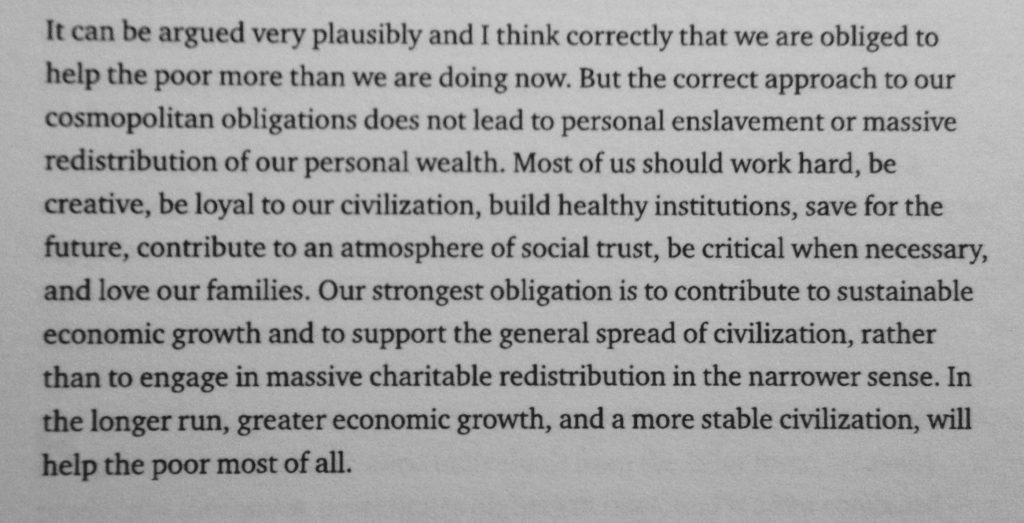
If you struggle to find the balance between donating 80% of your income to charity and retraining as a doctor to work in a children’s hospital in Africa, versus doing nothing, I recommend ‘Stubborn Attachments‘ by Tyler Cowen. In particular, may this passage reassure you:

fullsizerenderOr, as George Eliot ended Middlemarch:

“the growing good of the world is partly dependent on unhistoric acts; and that things are not so ill with you and me as they might have been, is half owing to the number who live faithfully a hidden life, and rest in unvisited tombs”


Decision making framework

6a00d83451620669e20133f351e64f970b

When struggling to make a decision a simple first step is to create three columns and list:

  • Reasons in favour
  • Reasons against
  • Further information required

I like the advice from Jack Reacher,

Evaluate. Long experience had taught me to evaluate and assess. When the unexpected gets dumped on you, don’t waste time. Don’t figure out how or why it happened. Don’t recriminate. Don’t figure out whose fault it is. Don’t work out how to avoid the same mistake next time. All of that you can do later. If you survive. First of all you evaluate. Analyse the situation. Identify the downside. Assess the upside. Plan accordingly. Do all that and you give yourself  a better chance of getting through to the other stuff later.

The following is a great template for requesting decision rights within an organisation:

  1. Describe the authority that is being requested
  2. Provide a background and summary of the value proposition
  3. Outline the objective with the strategic fit
  4. Prepare an economic summary with the base case, as well as other plausible scenarios that could make the project much better or worse
  5. Identify the key value drivers
  6. Describe the key risks and mitigants
  7. List alternatives considered and why they’ve been ruled out
  8. Project the timeline for future steps

See Koch, C., 2015, Good Profit, Crown Business

And all those points should be evidence-based. Not necessarily extensive, but easily digestible. As management guru Joey Barton points out, three key points are “the limit of relevant, easily digestible information”.

Rejection

photo

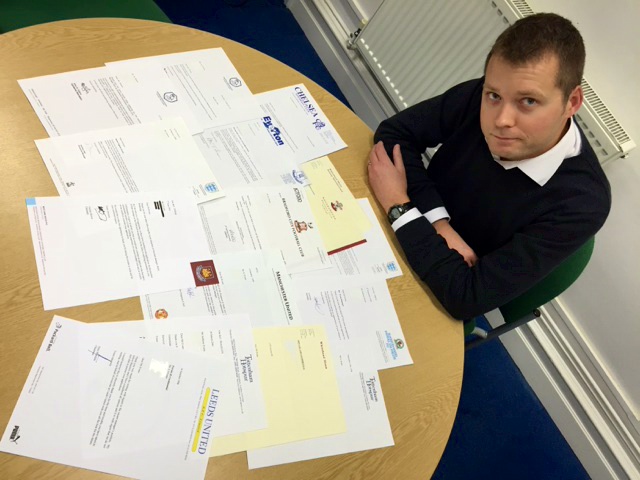
In May 1997 I applied for the Everton managers job, and received a nice reply from Peter Johnson. Over the next few years I decided to apply to as many Premier League managers jobs as I could, and eventually built a collection of rejection letters. I rediscovered them in November 2015 and here they are:

I still live in hope.

Update: here’s my pitch for the Everton job 2016


Thesis supervision

This page provides general advice for students writing a thesis or research report under my supervision.

The most important first step is to identify a research topic. I consider the power of economic reasoning to stem from its applicability, and take a broad and eclectic position of what would constitute suitable subject material. Therefore for a general management thesis I don’t require students to work on the same research topics that I do. A second step is to have a clear understanding of your audience. You should be able to visualise who you are writing for, and therefore what you need to achieve. A good way to develop awareness and understand a pracitioner audience is to read the following:

Harvard Business Review 

McKinsey Quarterly 

Knowledge@Wharton

For a standard empirical paper you need to ask an interesting question and deploy rigorous methods to answer it. That’s it. And yet most papers fail to do this. 

For a theoretical paper there is a closer boundary to journalism, but a big difference between good journalism and bad journalism. Your objective isn’t good journalism, it’s good research. Your learning journey isn’t research. 

A successful thesis will accomplish three things:

(1) Choose an insightful research question

The main difference between a very good thesis and an excellent thesis is whether or not you articulate, and answer, a good research question. In most theses that I see, this isn’t the case. Typically students will identify an interesting topic, and then proceed to investigate it. But the purpose of a thesis isn’t merely for you to learn about something, it’s about contributing to our collective understanding. I don’t expect students to have a good research question at the beginning of their project, but be wary of reaching the end of it without having one.

(2) Provide a rigorous literature review

A literature review is more than just a discussion of your topic, it is supposed to survey the existing literature that relates to your research question. For more see here: Writing a literature review.

(3) Utilise the right methodological framework

To start off with, I highly recommend the following articles on research design:

If you use standard research methods then be aware of the social priming replication crisis, publication bias and the problem with p hacking. For more listen to:

I would expect all theses to fit into one of the following categories:

  • Conceptual – this could be theory based, a comprehensive literature review, or some other form of non-empirical paper
  • Empirical – this is more common and investigates/answers the research question utilising data. We can split an empirical paper into 4 main sub-types:
    • Quantitative – this is the typical format for an economics paper and is based on the use of statistical tests and model building to analyse measurable phenomena.
      • The quality of a model rests on the use of control variables
      • The quality of a survey rests on the randomization strategy
        • Note that the common problems with surveys are survivor bias; the fact that they capture a snapshot rather than a trend; they provide only an indirect view of behaviour; and they have the potential for dishonesty from recipients. Useful remedies include posing questions in hypothetical situations, and a recognition/discussion that you are establishing upper or lower bounds (for more on the use of surveys in hostile contexts see Frye, 2017, p. 33-35)
    • Qualitative – these are descriptive accounts that value an interpretive approach
    • Mixed methods – i.e. combinations of both quantitative and qualitative research methods
    • Hybrid methods – e.g. the comparative method (QCA). (See here for an introduction to the comparative method).

We can consider a research report to be a different type of thesis, with more emphasis on explaining a novel topic and establishing some general insights that are relevant to managers, and less emphasis on original research.

Perhaps the key ingredient to a successful thesis is to demonstrate competent project planning.

This is crucial because it determines whether the experience is enjoyable or not. The following are necessary (but not sufficient) characteristics you need to have:

  • Enthusiasm for the research question (and not just the research topic)
  • Genuine desire to have people read your work
  • Ability to self-motivate
  • Swift communication

I will either provide you with detailed feedback on a full draft, or brief feedback on specific questions, but you should not expect me to provide multiple rounds of comments throughout the process. Depending on how many students I supervise in any given year, I intend to provide a similar amount of help to each and will be unable to devote significant time to your project close to the deadline. 

When planning the writing of the thesis take a look at:

This is also useful: Baylor University research planner guide.

For advice on writing see Barry Weingast’s ‘Caltech Rules for Writing Papers‘ and Mike Munger’s “3 simple rules for good writing:

If you get to present your work, here’s a good guide for creating a poster (and here). Don’t forget to include a clear plastic wallet with printed copies, and one for business cards.

Grading

Here is the way in which I judge academic articles and conference presentations. It contains information relating to research articles; theses; the use of data; and sociology challenges: Research Assessment.

For more details on the grade ranges that I typically employ see page 7 of my guide for students, however you should adjust the passing grades such that what I deem to be a C grade for a thesis would get a mark of 12-14; a B is 14-16 and an A is 16+. These are only general guidelines and there’ll always be a gap between my judgement and your understanding of my judgment. But just because the grading is subjective does not make it arbitrary.

Finally, if you’re interested in a career in academic economics, here is advice on surviving grad school. And if you are a female student, do take a look at this “Women in Economics” video series.

Last updated: September 2023

My Guide to Travel

parrot


May we enjoy the “free communication of friendship, the taste of reading and of travelling” (JB Say 1803)


I make a solo trip around once a month and have created a set of routines that serve me well. I find travelling to be an important component of being an academic because it provides time and space to concentrate and reflect. Some of the advice below is a little haphazard, but it’s a work in progress.

(1) Packing

For very short trips I’ll use a hold all but for anything more than 3 nights I’ll take a suitcase. From 2008-2022 I used my Rimowa Topas. This has the benefit of holding everything I need (I’ve used it for 2 week beach holidays) but small enough to fit as carry on if necessary, which is handy if there’s a queue for bag drop but I prefer to check it. I’ve only ever had my suitcase go missing once and don’t keep critical documents in it, but they are hassle to carry around with you (especially if you like to spend time at the airport). I very rarely clear customs before the baggage area at reclaim so I don’t feel that checked baggage slows me down. And for connecting flights it makes things significantly easier.

In 2022 I replaced my Rimowa for two main reasons. Firstly, I wanted a four wheeler because they are much more easy to maneuver when queuing. And secondly, because Rimowa were bought by LVMH and pivoted from being a brand focused on travel and quality to one focused on luxury and grotesqueness. I now use an American Tourister Novastream Spinner.

If you’re going to a conference don’t forget:

  • Non iron shirts – not because you don’t need to iron them (you do), but because they take less time to iron than normal ones.
  • Running shorts (for working in the hotel room, or running).
  • Swimming trunks (hotel will often have a pool).
  • A decent bar of soap.
  • A bluetooth speaker.
  • Tea bags (I used to hate green tea or fruit infusions but now I take a stash of tea bags that don’t require milk).
  • Plug adaptor.

I carry a charging station whenever I have a bag with me. The main items are a spare battery (handy for on the plane) and charging cables. I love the design of the Mu classic for when I’m in the UK but prefer to use a European or US charger (instead of taking an adapter) when abroad. I also include a small torch for blackouts.

A good wash bag should be light and adapt to the contents. There’s no point having a bulky item of luggage that is only half full. I pack the following:

  • Toothbrush (don’t forget a cover)
  • Travel size toothpaste
  • Razor (you don’t need shaving foam/cream)
  • Indigestion tablets
  • Aspirin
  • Deodorant
  • After shave bullet (note I refer to is as an “after shave bullet” rather than a “perfume atomiser”)
  • Chewing gum/mints
  • Cuff links
  • Contact lenses – switching to daily disposable ones has made a big difference because you don’t need to pack contact lens solution, and can swim in them

Note that all of these items are easy to duplicate. Therefore have them in your wash bag and keep them at home. What is the point in having to remember to pack and unpack your toothbrush before and after every trip? Duplicate!

(2) The airport

Yes, I know Tyler Cowen’s advice that if you’ve never missed a plane it means you’ve spent too much of your life at airports. But I do not understand this because time at an airport is highly productive. As Craig Mod says,

You are hacking the airport by arriving early, knowing that all the work you could have done at home — the emails or writing or photo editing — can be done at the airport.

Airports are outside any conventional time zone and so embrace this detachment. They are one of the few places where it’s socially acceptable to have a pint before 10am. Embrace this idiosyncratic! I plan to arrive at least 2 hours before my flight – even if I’m checked in, have my boarding card, and taking carry on luggage. For most people 30 minutes at home is better than 30 minutes at an airport, but once you pass security anxiety drops. Those extra 30 minutes you could have spent at home are fraught because you need to remember to remember your passport; consider traffic; wonder about queues, etc. Once you’ve cleared security you can relax. I don’t use lounges and am perfectly happy to just buy a coffee, find a seat, put on ear/headphones, and read a good book. For most people a 1 hour arrival is plenty of time, but I only do this if it’s less than a 30 minute drive to the airport; it’s a small airport; I know there won’t be a pleasant cafe beyond security; I’m really tired/hungover.

(3) The airplane

Try to stick to one airline. The benefits of a loyalty programme are worth being loyal for.

I need an aisle seat. Not just so that I can get to the toilet easily (which incentivises me to drink more water, which is good) but it also means that I can go for a walk to stretch my legs (also good). BTW it’s usually fine to use the toilet when the seatbelt sign is on and here are some excellent tips for getting more legroom.

Obviously if you are in an aisle seat you should be sympathetic to letting people get out. I will sometimes try to sleep and have no problem at all with being woken. The problem I have is people who are constantly getting things from their bags in the overhead locker. Those people are inconsiderate and evil. Even before having kids I was sympathetic to parents travelling with infants. Although they should stay in Economy.

What to wear on a flight:

  • A hoody is cosy and protects your head against unhygienic seats, but if you won’t wear it at your destination it is too much hassle. In which case wear a baseball cap. Or both.
  • A gilet is a clever way to have small items like mints, earphones and a mobile phone close to hand whilst being seated – you can get them for < £20.
  • Avoid a cold/sore throat from the poor quality cabin air by wearing a lightweight neck warmer.
  • High quality comfortable noise cancelling headphones are a must.

Embrace no wifi and read:

  • I like something light for takeoff and landing – The Economist, The Week, The Spectator, or New Statesman. Not a newspaper. I do not want newsprint on hands. The in flight magazine is usually a worthwhile backup.
  • Then a book. If you like kindle fine but I don’t get it. Who reads so much that they can’t carry hard copies? I often read “big” books. But I won’t get through more than 2 on a trip, so they are not prohibitively cumbersome. Even on a 2 week holiday pre kids I would get through 3 or 4 books, but someone else would have one I wanted to read. Books are portable. Durable. Enchanting.
  • Or, I may be reading some academic articles. I can see the point of an e reader then because a stack of papers is heavy. But I like to take notes in the margins, and I enjoy the process of throwing away articles once I’ve read them. So even if your hand luggage is a burden on the outbound journey, it will be much lighter on the return. I’ve found that too many articles, on an array of subjects, is too mentally taxing for a flight.

Or, just watch a movie. Apparently Baz Luhrmann began planning his screenplay for ‘The Great Gatsby’ whilst necking wine on a train through Europe. It reflected this speed and dizziness. I watched it whilst necking wine on a plane over the Pacific, and with proper headphones and a dark cabin I find the audio and picture quality perfectly engaging.

I’ve also started listening to more Podcasts whilst flying. They can be a good way to get through a drama series.

(4) Hotels

Try to stick to one hotel chain. The benefits of a loyalty programme are worth being loyal for.

The mark of a good hotel room:

  • A bath wide enough to shower in.
  • Electrical socket on the desk and on the bedside table.
  • A desk lamp with a switch on the base of the lamp (as opposed to on the wire, and therefore hidden behind the desk).
  • Blackout curtains.

(5) Transport

Uber is a game changer for domestic transportation. Whilst I don’t mind using public transport it can be almost impossible in the US, and I think it’s wrong to be insensitive to being ripped off on the grounds that you’re using expenses. When reliant on local taxis I’d often prefer to stay at the hotel, but Uber have made it cheaper and easier to get around. Critically they have removed the cultural uncertainty regarding appropriate fares and tipping; reduced suspicion about appropriate routes; avoided the need to carry cash; and lowered prices.

I totally agree with Michael Jennings’s account of “Why a traveller loves Uber“.

(6) Hospitality

Once upon a time I was fascinated by the amazing set of instructions that Richard Stallman sends his hosts. I have simple preferences (e.g. a working shower, mineral water) but put great weight on them being satisfied. One of my preferences is alone time. As Stallman says,

Many people assume that because I am traveling, I am having a vacation–that I have no other work to do, so I can spend the whole day speaking or meeting with people. Some hosts even feel that they ought to try to fill up my time as a matter of good hospitality. Alas, it’s not that way for me.

There are a few cities that I travel to frequently and will often try to spend time with friends. But there is an odd tendency from some cultures to feel obliged to “entertain” you, or to treat your whole schedule as theirs. If I’ve been in a classroom all day I may need the evenings to respond to emails and do other work. Learning that a mysterious person will be at my hotel room at 9pm to take me for dinner is my idea of hell.

When abroad I like to tip, and usually leave a tip when I check out of a hotel room. If I’m not sure what an appropriate tip is I use the price of a pint of beer in local currency as a good benchmark (and multiply accordingly).

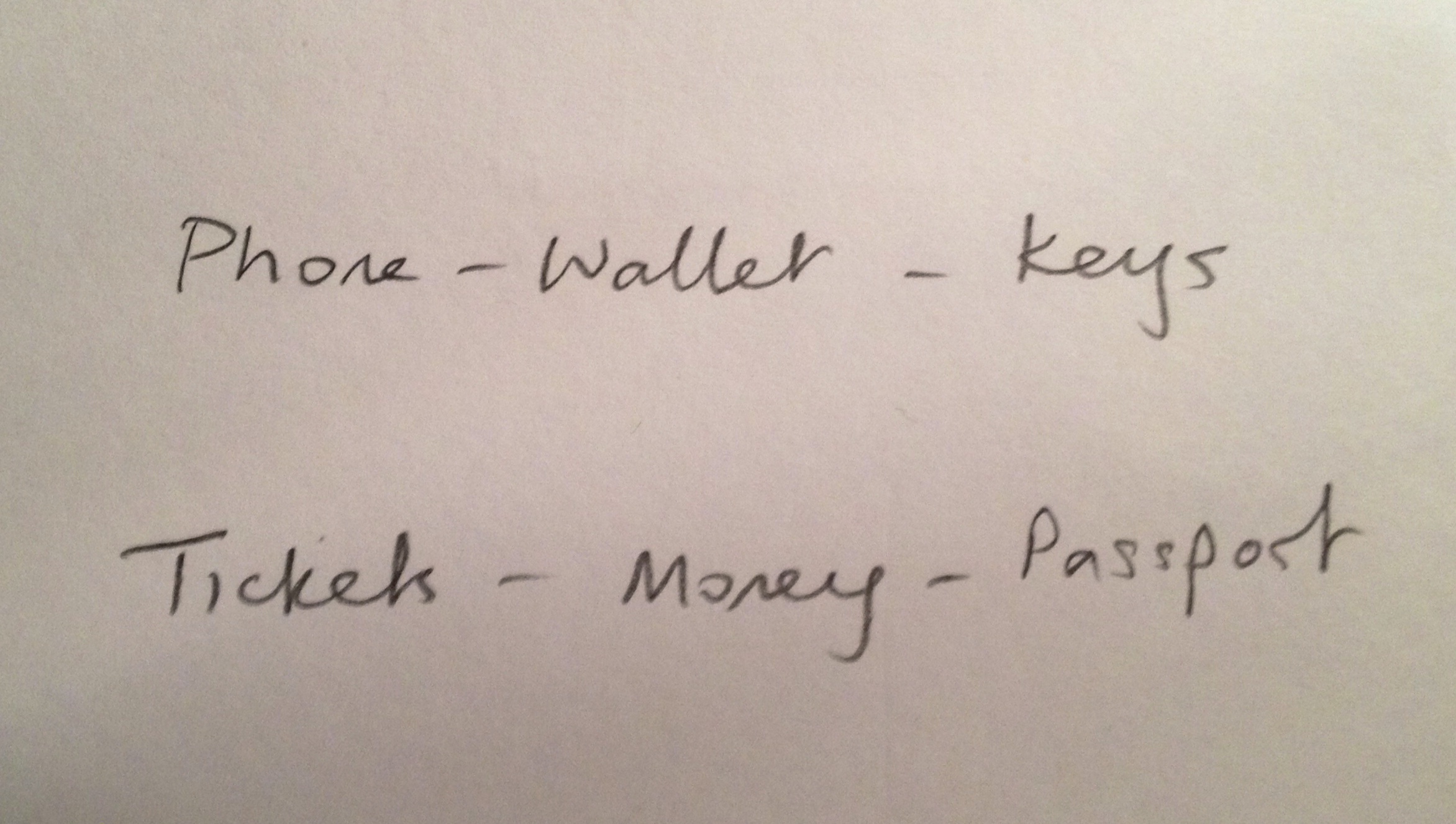
If you want a mantra, here’s mine. Top line is when I’m leaving the house, bottom for when I’m leaving the country. Tickets usually means “have I added my boarding card to Passbook?” Money includes foreign currency. Passport includes ESTA/visa. Easy!

photo

I am a creature of habit and get great benefits from the epistemic shortcuts of returning to the same place year after year after year after year after year after year. And recently I realised that I struggle to recollect anywhere that I’ve only been to once. It was only on my second trips to Perth, Bucharest, Turin, Sofia and Minsk that I felt I could piece any of those great cities together in my head. There is something about a return visit to confront your first impressions, and permit yourself a passage of time and circumstance, that makes it a necessary part of travel. It means you can’t get too far ahead of yourself, dipping in and out and passing through. For me, at least, I need to relate a city to my own past experiences. Going back to favourite places can also serve as a restorative niche, where you return to your true self.

Finally, when travelling, go that little bit further. I’ve realised that many of my most meaningful travel experiences are when I’ve ventured slightly farther than my original plans. In 2014 I visited Atlanta and on a whim decided to rent a car and drive to Montgomery. It was exciting and felt like genuine adventure. When I visited Minsk in 2018 I took the time to jump on a train north. It gave me an additional reference point, heightening my understanding of the country, and providing an opportunity for independence. As much as I love the routine of travel described further up the page, all the more reason to seek out the circumstances for surprise. It’s precisely because I stay at Holiday Inns so often that a local hotel, in the right circumstances, becomes exciting.

Game practice

We think that games have an important place in cultivating good strategists, and that now more than ever games can give executives an edge over their competition.
Reeves and Wittenburg, Harvard Business Review


In addition to my online (and offline) course on Game Theory, I also offer students the opportunity to enjoy some “Game Practice”. Get in touch if you would like me to organise sessions of any of the following:

  • Carcassonne
  • Settlers of Catan
  • Dominion
  • Hive
  • Biblios
  • Risk

I also recommend Eleusis, which is a great game to understand inductive reasoning. And Tic-Tac-Toe is just fun!

A Short Introduction to Macroeconomic Policy

64863_428871333867799_2124504579_n

Introduction

This short course provides an overview of the ways in which governments try to influence the economy. It will provide an explanation of what monetary and fiscal policy are, and why they are used. We will assess the ECB’s response to the financial crisis and the 2009 Obama stimulus bill. Emphasis will be on providing a framework for participants to refine their own opinions.

Prerequisites

The course does not rely on any previous study of economics. However, a familiarity with economic terms (such as “inflation”, “GDP”, “balance sheet”), and an awareness of contemporary policy debates (such as zero lower bound monetary policy), will be useful. The course is aimed at people who watch Newsnight but don’t quite feel they understand the economic foundations of what’s being said.

Teaching methods

  • Lectures (2 sessions)
  • Case discussion (1 session)
  • Workshop (1 session)

Textbook

The only mandatory readings are provided in the schedule below. However the course is designed to tie into the following (amazing) textbook:

The website for the book contains an array of other resources: https://anthonyjevans.com/books/markets-for-managers/

An additional reading list is available here: https://anthonyjevans.com/2010/03/course-readings/

An edited list of highly recommended articles from The Economist is here: https://anthonyjevans.com/2011/05/the-economist-an-mba-reader/


Schedule 

9:00am  Breakfast

9:15am  Welcome address

9:30am Session 1: Monetary policy: A Beginner’s Guide to Central Banking*

Video: “An introduction to the Dynamic AD-AS model

11:15am Break

11:30am Session 2: The Euro in crisis

“The Euro in Crisis: Decision Time at the European Central Bank” Harvard Business School case no. 9-711-049 (£)

Questions: 

1. How does the ECB conduct monetary policy?

2. What actions were taken after the BNP Paribas freeze?

3. How do these actions compare to the Federal Reserve?

1:00pm Lunch

2:00pm Session 3: Fiscal policy: The Confidence Multiplier*

3:30pm Break

3:45pm Session 4: Workshop

Market for Managers Problem Set

Questions: 7.1, 7.2, 8.1, 8.2, 8.3, 8.4, 8.5, 8.6, 8.7, 8.8, 8.9, 9.1, 9.2, 9.4

4:45pm Debrief

5:00pm Finish

Note: Sessions marked with an asterix (*) have a lecture handout available in advance. Cases marked with a pound sign (£) will be distributed in advance.


Extensions

The course does not cover the following: international economics, business cycle theory, growth theory, supply-side economics.

Numeracy Skills Bootcamp

bertrand-russell
In 2008 I was asked to provide a short, intensive bootcamp for incoming students. This page is a collection of the resources that I used for that course. It contains some slides that define and explain key concepts, and also provides some examples of numeracy tests. In addition, I noticed that many students – particularly females – felt that they “weren’t math people”. I’ve done a video to discuss these fears. I hope you find these resources helpful.

I also recommend the following page, which is full of links:


Part 1. Fundamentals of Mathematics


 Download the handouts here.

  • Socrative Quiz: Fundamentals of Mathematics

Additional topics:

Some fascinating ideas:

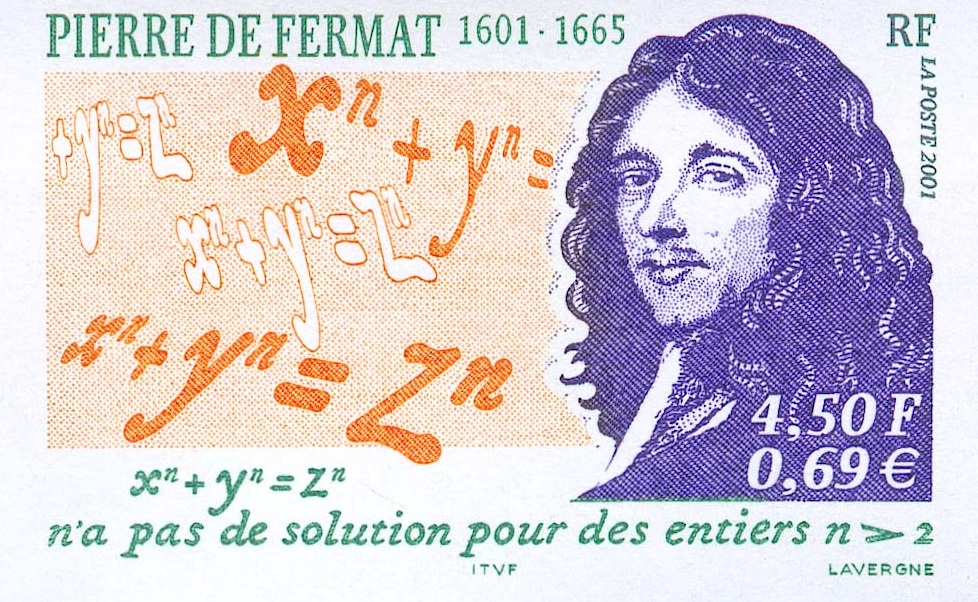
fermat


Part 2. Practice Tests

Download the handouts here.


Additional resources:


Part 3. Gender Differences & Mathematics


Download the handouts here.

Further reading:

And remember:

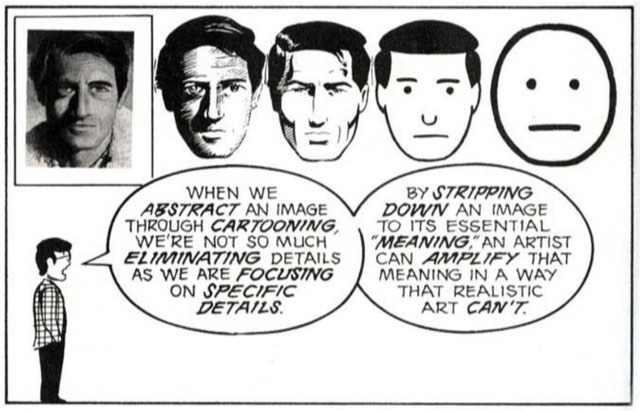
comics-abstraction


This is part of my online course on Analytics.

An Introduction to Game Theory

Game Theory provides a clear and engaging way to study strategic interaction and constitutes a critical foundation for corporate leaders. This module covers the basic terminology and foundational concepts that form the scientific basis for game theory, and then applies them to a range of social and management issues. 

This page provides a basic understanding of what Game Theory (“the science of strategy”) is, and how it can be utilised in management situations. In addition to providing my own course material, I have also attempted to tie into some of the amazing resources that already exist.

Lecture handout: Game Theory*

Activity: Game Theory Worksheet and Obedient Prisoners
  • Other good activities to accompany the Game Theory lecture include: Oligopoly Game 42 and “Cheating for a £20”.
  • I like to follow the lecture on Game Theory with an interactive session on Oligopoly.
  • Here is my attempt to introduce some Game Theory into the classroom.
  • Further reading: “Platform Business for Everything”, in Fisman, R., and Sullivan, T., The Inner Lives of Markets, John Murray Learning, p124-126
  • Further reading: “Game Theory: A Beautiful Mind” Chapter 2 of Rubenstein, A.,  Economic Fables
  • More resources: Axelrod’s Tournament, and RadioLab’s episode on Tit for Tat with forgiveness

Here is a video on finding a Nash equilibrium:

Additional readings

Here are some recommendations, depending on your level of interest and time constraints:

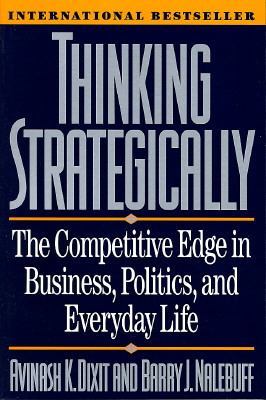
But the Game Theorist’s “bible” is Thinking Strategically” by Dixit, A., and Nalebuff, B (Norton, 1993). This is the one book you need to read, re-read, and master.

103592

Game theory is the science of strategy. What is strategy? As Jack Reacher understands, It was the other guy that mattered. (Child, L., 2012, A Wanted Man, Bantam Books, p.503)


Finally, it is great fun to apply Game Theory to popular culture. See Michael Statsny’s discussion of game theory in movies, and a collection of popular cultural references. Here are some of my favourite discussion questions:

I also like these two classic clips from Goldenballs:


Learning Objectives:

  • Become familiar with the key terms used by game theorists and recognise the seminal examples
  • Think in game theoretic terms
  • Apply game theory insights to real world management issues