Recommended pop economics

tumblr_m8r8syOhDw1qje6oyo1_500

Hazlitt, Henry (1946) Economics in One Lesson, Harper and Brothers

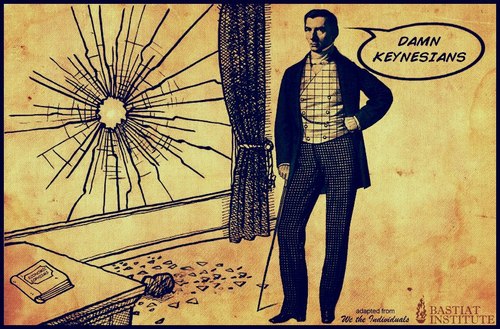
  • The original attempt to explain economic reasoning to non-economists, and an excellent utilisation of the broken-window fallacy.

Landsburg, Steven (1993) The Armchair Economist, Simon & Schuster

  • Provocative and intellectually stimulating.

Harford, Tim (2006) The Undercover Economist, Oxford

  • Less contrarian than Landsburg and contains more principles of economics than Levitt & Dubnar. A useful alternative to a textbook.

Cowen, Tyler (2007) Discover your Inner Economist, Penguin

  • One of the sharpest minds applying basic economic reasoning to an array of social situations.

Frank, Robert (2007) The Economic Naturalist, Basic Books

  • Somewhat repetitive reiteration of the point that economics can explain many social curiosities by recognising that things happen when the benefits exceed the costs.

Harford, Tim (2008) The Logic of Life, Little Brown

  • An extension and update to Gary Becker’s classic The Economics of Life (1995).

Course readings

1036774

I am conscious that my students will not forge an academic career, and therefore my aim with this reading list isn’t to develop technical capabilities but to confront intuition and to stimulate interest. My aim is to highlight four classic and under appreciated articles for each chapter. I am continuously updating this list, so please let me know what you think.

I don’t tend to link to encyclopedia or newspaper websites that explain important concepts. For that, Wikipedia – the second most important website of all time – is your friend.

1. Incentives matter

Also see Gneezy, U., and Rustichini, A., 2000, “A Fine is a Price” Journal of Legal Studies, 29(1):1-17 – the classic Israeli daycare study.

2. Cost and choice

  • Drucker, Peter, 1995, “The Information Executives Truly NeedHarvard Business Review Vol 73, Issue 1, pp.54-62 – Understanding how companies can use information to engage in genuine wealth creation.
  • Steele, Jeffrey, 1998, “The Origins of EVA”, Chicago Booth Magazine – a good summary of the origins of how to apply opportunity cost reasoning to internal financial reporting.

3. Market exchange

  • The Bidding game, National Academy of Sciences, March 2003 – A good, short, overview of auction theory and practice.
  • Tabarrok, A., and Cowen, T., “The End of Asymmetric Information” Cato Unbound, April 6th 2015 – A discussion around the claim that technological developments are reducing the problem of asymmetric information.
  • Roth, Alvin E., “Art of designing markets“, Harvard Business Review, Oct 1st 2007 – Examples of market design from the master.
  • Barnett, J.M., 2011, “The Host’s Dilemma: Strategic Forfeiture in Platform Markets for Informational Goods“, Harvard Law Review – Barnett provides an economic explanation for why platforms give away access to core technologies: it increases user investment and increases the platforms value. But this creates a double edged sword because platform providers face a trade off between being open (and generating users) and regulating access (to monetise).
  • Also: McMillan, J., 2002 “Come bid!” (pp. 75-88 and 68-72) in Reinventing the Bazaar

4. Prices and economic calculation

  • McAfee, Preston “Price Discrimination“, in 1 Issues in Competition Law and Policy 465 (ABA Section of Antitrust Law 2008) – A theoretical treatment of alternative types of price discrimination.
  • Manne, H.G., 2005, “Insider trading: Hayek, virtual markets, and the dog that did not bark”, Journal of Corporation Law 31(1):167-185 – A defense of insider trading from the perspective of internal markets and corporate information flows
  • Malone, Thomas W., “Bringing the Market Inside” Harvard Business Review, April 2004 – Pros and cons of companies that decentralise decision making and set up internal markets.
  • Newhard, J.M., 2014, “The Stock Market Speaks: How Dr Alchian Learned to Build the BombJournal of Corporate Finance, 27(C):116-132 – Newhard reveals the story of the world’s first event study, which occurred when Armen Alchian attempted to use publicly available  information relating to the share prices of various companies to establish that lithium was used as the fissile fuel
  • Also: Fisman, R. and Sullivan, T., 2013, “What Management is Good For” (Chapter 5) in The Org: The Underlying Logic of the Office, Twelve – A defence of the practice of management, and an account of its continued importance.

5. Competition and the market process

6. Capital theory and recalculation

7. Public finance

8. Monetary theory

9. Fiscal policy

10. International economics

  • World Bank, “Assessing Globalization” Part 1, 2, 3 and 4 – A useful collection of papers on empirical evidence around globalisation.
  • Richman, Sheldon, “The goal is freedom: Made everywhere” The Freeman, February 23rd 2007 – A passionate claim that the concept of “imports” and “exports” has no economic meaning.
  • Obstfeld, M., & Rogoff, K. (1995). The Mirage of Fixed Exchange Rates. The Journal of Economic Perspectives, 9(4), 73-96. – A theoretical explanation for the fragility of fixed exchange rate systems – there is usually no technical constraint on governments providing sufficient reserves to cover base money, however it is almost impossible to credibly signal that they will ignore the resulting domestic economic hardship (due to high interest rates). Also includes an interesting case study of Mexico 1994.
  • Weisbrot, M., “Ten years after: The lasting impact of the Asian financial crisis” Center for Economic and Policy Research, August 2007 – A reflection on the East Asian crisis with a focus on the role of the IMF
  • Chiodo, Abbigail J., and Owyang, Michael T., “A Case Study of a Currency Crisis: The Russian Default of 1998“, 2002, The Federal Reserve Bank of St. Louis – A review of different models and identification of specific triggers for currency crises.

Here is a selection of critical discussion over globalization:

11. Behavioural economics

  • Lambert, Craig “The Marketplace of Perceptions”, Harvard Magazine, March-April 2006 – A summary of chief insights from behavioural economics and neuroeconomics
  • Beshears, J., and Gino, F., “Leaders as Decision Architects” Harvard Business Review, May 2015 – A good overview of the difference between Type 1 and Type 2 thinking, and how organisations can implement processes to improve decision making
  • Smith, V. L. (2002) “Constructivist and Ecological Rationality in Economics” Nobel Prize Lecture – An explanation of the difference between constructivist and ecological rationality
  • Also: Poundstone, W., (2011) “Prospect Theory” (Chapter 16) and “Ultimatum Game” (chapter 18) from Priceless: The Hidden Psychology of Value, One World – Good introductions to key concepts

12. Global prosperity

  • Acemoglu, D., 2009 “Epilogue: Mechanics and Causes of Economic Growth” in ‘Introduction to Modern Economic Growth’, Princeton University Press – A summary of key insights about growth theory from one of the leading practitioners.
  • Jones, C., 2015, ‘The Facts of Economic Growth‘ – an encyclopedic account of the main facts about growth
  • Laar, Mart, 2007, “The Estonian Economic Miracle” Heritage Foundation, Backgrounder No. 2060 – A case study of Estonia’s post-Soviet economic reforms.
  • Isern, Joseph and Pung, Caroline, “Driving Radical Change” McKinsey Quarterly 2007, Issue 4, pp.24-35 – Parallels between economic transition (e.g. shock therapy) and initiating change within an organisation.
  • Also: Leighton, Wayne and Lopez, Edward, “Public Choice”, Chapter 4 in ‘Madmen, Intellectuals and Academic Scribblers’, Stanford University Press 2013 – An engaging history of the subject.