Behavioural economics

| Lecture handout: Behavioural economics* |
Textbook Reading: Chapter 11
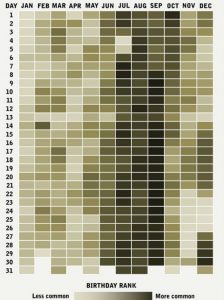
Here is an explanation of the Birthday Paradox (and here is an intuitive proof). Notice that the probability calculation assumes a uniform distribution (i.e. that there’s a 1/365 chance of being born on any given day). In fact, birthdays in July, August and September are more common than other months.
This applet allows you to play multiple games of the Monty Hall problem.
An article in the Smithsonian Magazine asks “When Did Girls Start Wearing Pink?”
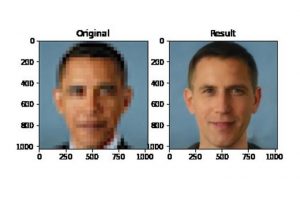
I used a pixelated image for an example of confirmation bias, and so I found it very interesting to see this example of bias contained within AI trained super resolution:
This article contends that the typical story about the McDonald’s lawsuit is wrong:
- Lopes, G., “What a lot of people get wrong about the infamous 1994 McDonald’s hot coffee lawsuit”, Vox, December 16th 2016.
And I’ve seen some reports that a judge subsequently reduced the award, and they ultimately settled for around $500,000.
Here is more on the McDonald’s case:
- “The Truth Behind the Infamous McDonald’s Hot Coffee Case” By A.J. Serafini, Poole Law Group
| Case: “Sun: A CEO’s Last Stand”, Business Week, July 26th 2004 (£) |
| Instructor Resource: A List of Behavioural Anomalies, March 2011 |
| Activity: Complete this Sun Microsystems quiz |
The identification of behavioural anomalies has often been used as a justification for government intervention. But as Mike Munger warns,
“Every flaw in consumers is worse in voters”
Therefore we should be skeptical of fixing market failures through democracy.
If all “nudge” theory says is that defaults matter then that’s fine. Inertia is real. But the implication of this is that mandatory savings schemes for younger workers should be in high growth funds. In fact, they’re typically in more conservative ones. So by the logic of nudge it’s the wrong outcome.
Recommended books
- Poundstone, William (2010) Priceless: The Hidden Psychology Of Value Oneworld
- Kahneman, Daniel (2011) Thinking, Fast and Slow Farrar Straus and Giroux – there are a lot of books that attempt to explain the main findings of behavioural economics, but this is the best. Written by an expert in the field, it reads more as an intellectual biography and tender ode to his deceased co-author, Amos Tversky. We learn more about the genesis of those classic original experiments, and how to implement those behavioural “anomalies” into business decision making. The chapters are short and immersive, and gradually build the concepts and insights into an incredibly important resource.
Recommended articles
- Lambert, Craig “The Marketplace of Perceptions”, Harvard Magazine, March-April 2006 – A summary of chief insights from behavioural economics and neuroeconomics
- Tabarrok, A., “A Phool and His Money” Review of Phising for Phools: The Economics of Manipulation and Deception, 2015, George A. Akerlof and Robert Shiller, Princeton University Press – A defence of standard economic theory against behavioural claims
- Also: Poundstone, W., (2011) “Prospect Theory” (Chapter 16) and “Ultimatum Game” (chapter 18) from Priceless: The Hidden Psychology of Value, One World – Good introductions to key concepts
| Learning Objectives: Apply a range of examples of behavioural anomalies to real business situations. Understand behavioural anomalies in light of an ecologically rational framework. |